Why is Canada's inflation high? Gasoline, not prices broadly
Canada's inflation was 3.1% in September 2026, but 2.1% once food and energy are removed. Gasoline, up 27.8%, explains the gap. What that means for rates and budgets.
Canada’s inflation is an energy story, not a broad one. In September 2026 consumer prices were 3.1% higher than a year earlier, but only 2.1% higher once food and energy are left out. Gasoline alone rose 27.8%.
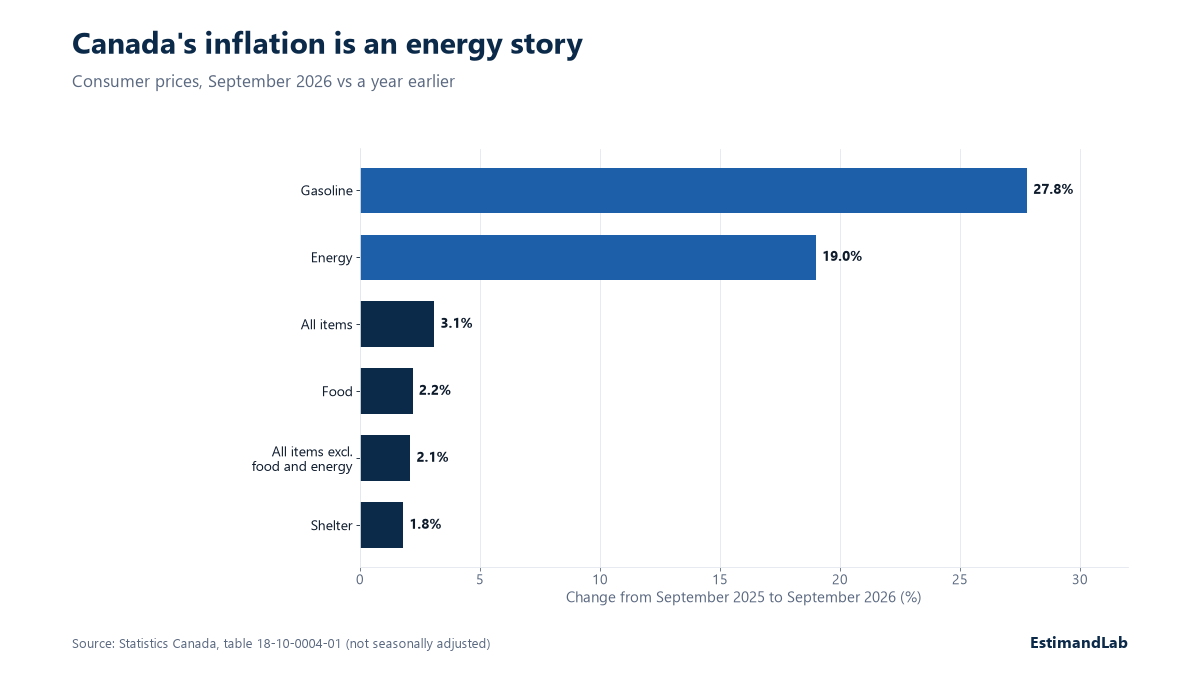
The numbers
| Canada, September 2026 vs September 2025 | Change |
|---|---|
| Gasoline | +27.8% |
| Energy | +19.0% |
| All items | +3.1% |
| Food | +2.2% |
| All items excluding food and energy | +2.1% |
| Shelter | +1.8% |
Headline inflation was 3.0% in August, so the September figure is a step up of 0.1 points [1]. The step came from gasoline, which rose 22.8% in August and 27.8% in September. Excluding gasoline, inflation was 2.2%.
Shelter rose only 1.8%. Food bought in stores rose 1.7%, the smallest yearly increase since May 2024 [1].
Why
Statistics Canada ties the energy rise to crude oil, which reached its highest level since May amid uncertainty about conflicts in the Middle East [1]. The September data were released on October 19, 2026.
On October 28 the Bank of Canada raised its policy rate by 0.25 points to 2.5%. It said inflation had been around 3% since April and that it expects about 3.5% by the end of the year. It also said that core measures remain close to 2%, and that the increase aims to stop high energy prices spreading to other prices [2].
Our reading is that the data supports the Bank’s concern about spread, but not yet a broad price problem. A rate increase cannot lower the price of crude oil. It can only stop higher fuel costs from becoming higher wages, rents and shelf prices.
What it means
For a household. Fuel is the line that moved. A commuter or a rural household feels more than 3.1%, and a household that drives little feels less. Borrowers with variable-rate loans now pay more after the October increase. For a business. Do not read 3.1% as a signal that all your costs are rising. Separate the contracts and suppliers tied to fuel from the rest, and review fuel surcharges against the 27.8% figure. Use the ROI and payback calculator to test whether efficiency spending pays back faster at current fuel prices.
For an investor or lender. The pattern in this data is a high headline with a quiet core. If energy prices ease, headline inflation falls toward the core without rates doing the work. If they stay high, the risk the Bank named, pass-through to other prices, is the thing to watch. How long rates stay high depends on whether the core starts to move.
For a policymaker. Judge inflation by the core measures and by how fast energy costs reach other goods, not by the headline alone.
The limits
This is one month of data, not seasonally adjusted, and “excluding food and energy” is one of several core measures. The Bank looks at others. The October figures are due on November 16.
Sources
- Statistics Canada, The Daily, "Consumer Price Index, September 2026", https://www150.statcan.gc.ca/n1/daily-quotidien/261019/dq261019a-eng.htm, and table 18-10-0004-01, https://www150.statcan.gc.ca/t1/tbl1/en/tv.action?pid=1810000401 (checked 2026-10-29)
- Bank of Canada, press release, October 28, 2026, https://www.bankofcanada.ca/2026/10/fad-press-release-2026-10-28/ (checked 2026-10-29)
We first posted this finding on X: https://x.com/EstimandLab/status/2115491176581324819