Why do mobile phone prices differ so much across the EU?
From 2019 to 2025 mobile service got 37% cheaper in France and 51% dearer in Poland. One single market, very different bills. What the gap says and what to do.
Mobile phone service is the same technology across the EU, yet prices moved in opposite directions. From 2019 to 2025, the price index for mobile service fell 37% in France, 32% in Austria and 29% in Belgium. It rose 51% in Poland, 31% in Slovakia and 27% in Latvia. The EU average fell 7%.
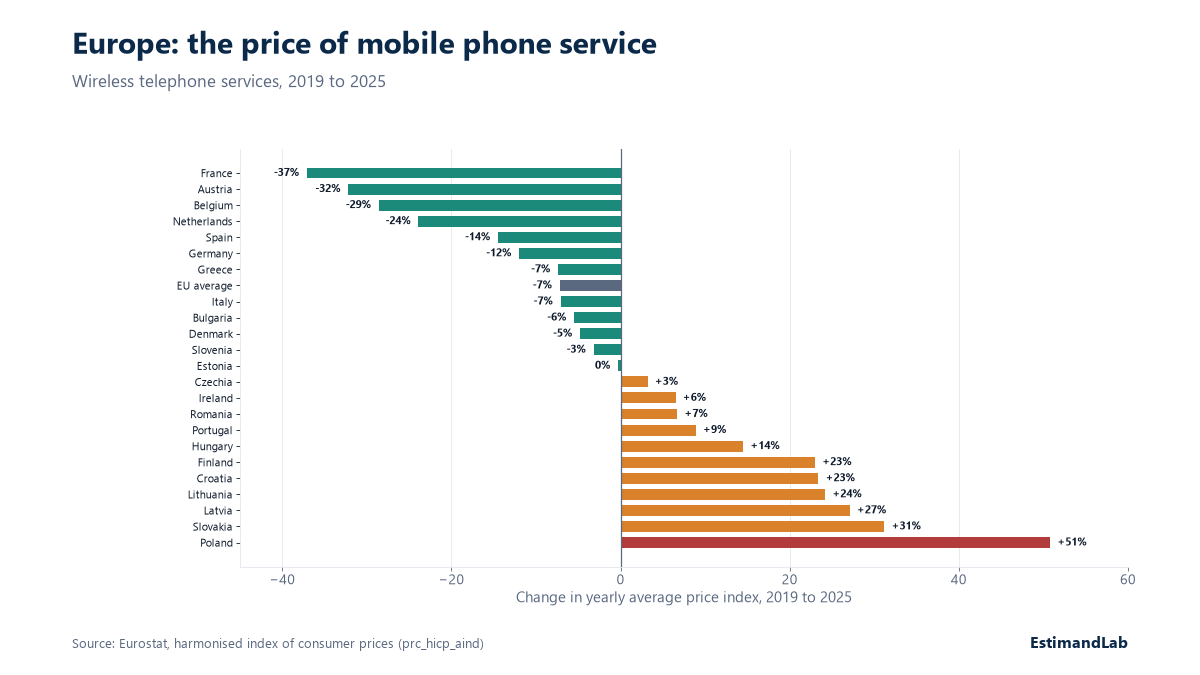
The numbers
| Mobile phone service, 2025 vs 2019 | Mobile prices | All prices |
|---|---|---|
| France | -37% | +19% |
| Austria | -32% | +30% |
| Belgium | -29% | +26% |
| EU average | -7% | +26% |
| Slovakia | +31% | +40% |
| Poland | +51% | +47% |
France and Poland are 88 percentage points apart. The index tracks the price of a comparable service, so it is not the same as a monthly bill, which also depends on what a customer chooses to buy [1].
The gap looks different next to each country’s own inflation. In Poland, mobile prices rose 51% while all prices rose 47%, so mobile service held roughly steady against everything else. In France it fell 37% while all prices rose 19%, a large real fall [1].
Why
The EU sets common rules, but each country has its own network operators, regulator and rules on price plans. Telecoms regulators note that mobile markets usually have three to five operators with their own networks and high barriers to entry, and that a change in the number of operators can push prices up or down [2].
The data do not say why France fell and Poland did not. Our reading is that the difference is in how each national market is run, which means how many operators compete and how hard they compete on price. That is a reading, and it is testable. The questions to ask are whether operator numbers, entry of a new player or a regulator’s decision came before the price change in each country.
What it means
For a household. Your own country’s market sets your bill, and you can often do something about it. Compare plans every year, and treat a long contract at a fixed price as a bet on what the market will do. For a business. Telecom is a cost where an annual benchmark pays. Ask what a comparable plan costs from other operators, and use that in the renewal. For an investor. Price direction differs by country, so treat telecom as a set of national markets. Competition is the variable to watch when you assess any one of them.
For a policymaker. A single market does not produce a single price. Where mobile prices rose faster than general inflation, the national competition authority has a case to examine. Program evaluation methods can test whether a rule change, such as a new entrant or a merger decision, moved prices.
The limits
These are changes, not price levels, and a country that fell by a third may still be dearer than one that rose. The comparison covers yearly averages for 2019 and 2025 and does not follow what happened in between. Sweden has no value in this series, and countries outside the euro report in their own currency. The figures use the EU of 27 countries for the average.
Sources
- Eurostat, "HICP - annual data (average index and rate of change)", table prc_hicp_aind, coicop CP08302 (wireless telephone services) and CP00 (all items), index 2015=100, https://ec.europa.eu/eurostat/databrowser/view/prc_hicp_aind/default/table (checked 2026-10-29; the 2025 annual data are the newest published)
- BEREC, "Report on post-merger market developments: price effects of mobile mergers in Austria, Ireland and Germany", BoR (18) 119, June 2018, https://www.berec.europa.eu/en/document-categories/berec/reports/berec-report-on-post-merger-market-developments-price-effects-of-mobile-mergers-in-austria-ireland-and-germany (checked 2026-10-29)
We first posted this finding on X: https://x.com/EstimandLab/status/2115514394390204854