Canada's new business rate fell to 12.3% in 2023
In 2023, 12.3 of every 100 Canadian employer businesses were new and 11.9 closed. The 0.4 point gap is the smallest since 2016, apart from 2020. What it means.
In 2023, 12.3 of every 100 Canadian employer businesses were new, and 11.9 closed. That 0.4 point gap between entry and exit is the smallest since 2016, apart from 2020. Canada replaced the firms it lost in 2023 and added almost nothing on top.
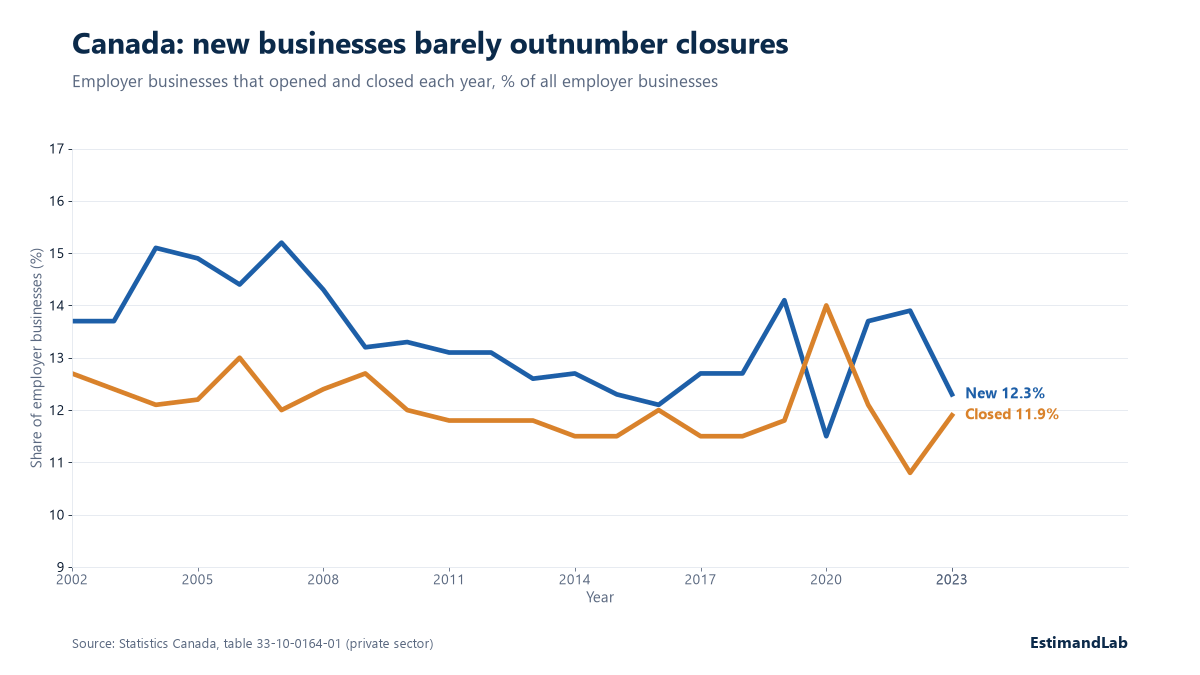
The numbers
| Canada, private sector | Entry rate | Exit rate | Gap |
|---|---|---|---|
| 2016 | 12.1% | 12.0% | 0.1 |
| 2019 | 14.1% | 11.8% | 2.3 |
| 2020 | 11.5% | 14.0% | -2.5 |
| 2022 | 13.9% | 10.8% | 3.1 |
| 2023 | 12.3% | 11.9% | 0.4 |
In 2023 there were 145,480 entrants and 140,130 exits among 1,184,830 active employer businesses. The net gain was about 5,340 businesses, or 0.5% [1][2].
Entry fell 1.6 points from 2022 and exit rose 1.1 points. 2022 had the lowest exit rate on record, so 2023 is partly a return to normal, but entry fell below the level of 2021 and 2022.
By sector, entry was below exit in 2023 in wholesale trade (5.5% against 7.8%), management of companies (8.1% against 11.2%), finance and insurance (11.3% against 13.4%) and mining and oil and gas (8.5% against 10.6%). Accommodation and food services (11.3% against 10.2%) and construction (11.5% against 11.0%) had more entries than exits [1].
Why
Statistics Canada points to a hard operating year: rising inflation, input costs and interest rates, and business insolvency filings up 41.4% from 2022 [2]. It also says that new businesses play a modest role in job creation. In 2023 entrants contributed 1.3 points to a gross employment creation rate of 10.7%, while growing existing businesses contributed 9.4 [2].
Our reading is that 2023 looks like a rebound year running out. Entry was high in 2021 and 2022 after the sharp 2020 drop, and 2023 is closer to the 2015 to 2018 range of 12.1% to 12.7%. The data show a market that is replacing exits one for one, with little net growth.
What it means
For a buyer or household. A market with few new entrants has fewer new offers. In sectors where entry sits below exit, such as wholesale, the number of firms is shrinking.
For a business owner. Existing firms face less new competition, but also a supplier base that is thinning in some sectors. Check how many of your own suppliers have a replacement ready.
For a founder. A year with entry close to exit is not a sign that starting up is hopeless. It is a sign that the average start-up is not adding much to the stock of firms. Test the case with the ROI and payback calculator before you commit.
For a policymaker. Entry is one measure to evaluate programs against. If a program aims to help start-ups, track entry and exit by sector and firm size, and compare with sectors that did not get the support. Program evaluation sets that design out.
The limits
The table counts private sector employer businesses only, so self-employed people with no payroll are not in it. One year does not make a trend. The latest year published is 2023, released on February 12, 2026, so 2024 is not yet available.
Sources
- Statistics Canada, table 33-10-0164-01, "Business Dynamics measures, by industry", https://www150.statcan.gc.ca/t1/tbl1/en/tv.action?pid=3310016401 (checked 2026-10-29)
- Statistics Canada, The Daily, "Business and employment dynamics data, 2023", February 12, 2026, https://www150.statcan.gc.ca/n1/daily-quotidien/260212/dq260212a-eng.htm (checked 2026-10-29)
We first posted this finding on X: https://x.com/EstimandLab/status/2115207440300171716