Are companies hiring fewer people because of AI?
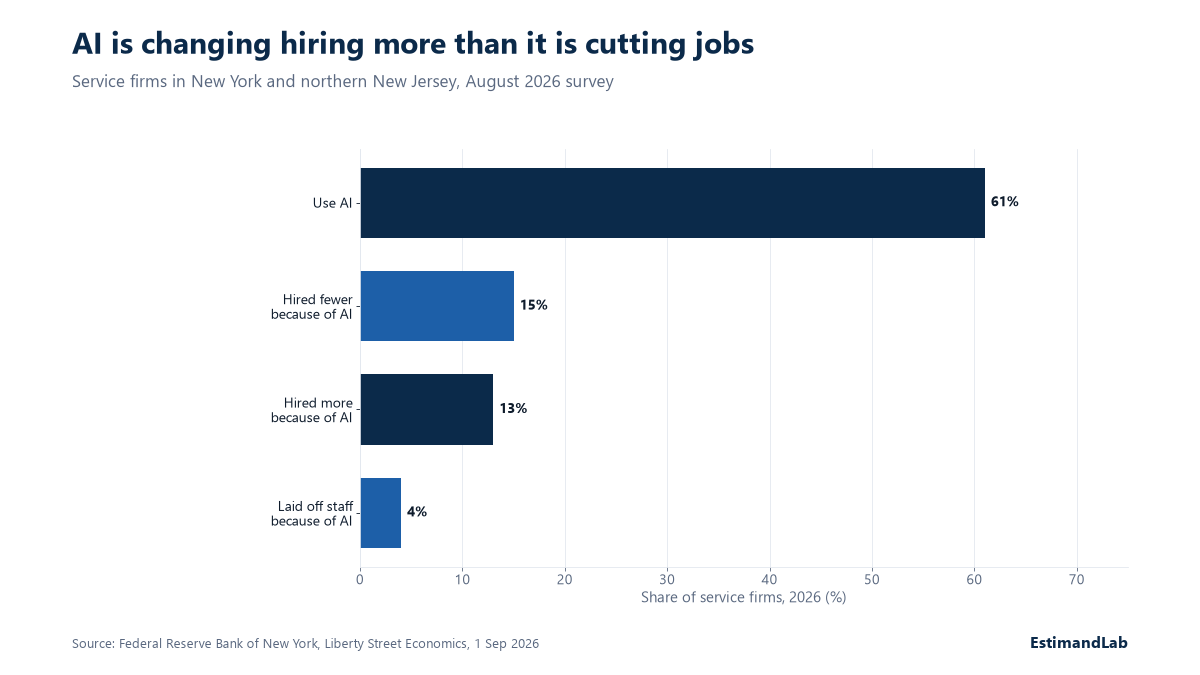
A New York Fed survey of service firms finds AI is changing hiring more than it is cutting jobs. 61% use AI, 15% hired fewer people because of it and 4% laid people off.
AI is changing who gets hired much more than who gets fired. In the New York Fed’s 2026 survey of service firms, 61% use AI, about 15% hired fewer people because of it, about 13% hired more, and 4% laid people off [1].
The numbers
Use of AI has grown fast. Among service firms it went from 25% in 2024 to 40% in 2025 and 61% in 2026. Among manufacturers it went from 16% to 26% to 51%.
Layoffs are still rare, but they are rising from a low base. Among service firms, 4% laid off staff because of AI, up from 1% a year earlier. The share that hired fewer people rose from 12% to about 15%. The share that hired more stayed near 13%.
The use is thin. About three quarters of service firms call their AI investment minimal to modest. At firms that use AI, the median share of workers using it is 17% in services and 7% in manufacturing. A little over a third of AI-using service firms retrained staff because of it.
What the study did
The authors, Jaison Abel, Richard Deitz, Natalia Emanuel and Nick Montalbano, use the New York Fed’s regional business surveys of firms in New York and northern New Jersey. Each August since 2024 the surveys ask whether a firm used AI in its business processes over the past six months, and whether that changed its staffing. The post is a central bank research note, not a peer-reviewed paper. It does not report how many firms answered.
Our reading
The headline to take from this survey is about hiring, not layoffs. A layoff is visible. A job that is never posted, or a vacancy left unfilled because AI covers the task, leaves no trace in layoff counts. In this survey the firms that hired fewer outnumber the firms that hired more, 15% to 13%, and both outnumber the firms that laid people off.
For a manager, this means the real decision sits in each hiring request. Ask for the task-level case. Which work will the tool take over, how will you measure that it did, and what happens to the person who would have done it?
For a board, track hires, vacancies and retraining spend by function, not only headcount cuts. That is where the effect shows first.
For a regulator or labour economist, layoff statistics will understate the change for some time. Our reading is that entry-level hiring is the place to look.
Measure before you believe. A firm that says AI saved it two hires should be able to show the work volume that stayed constant.
Limits
This is one region, one month each year, with answers that firms attribute to AI themselves and no published sample size. The post’s text gives the hiring and layoff shares as shares of service firms, but its chart labels them shares of AI users. It describes 2026 and says nothing about where adoption goes next.
We first posted this finding on X: https://x.com/EstimandLab/status/2115457678449520909
Sources
- Abel, J., Deitz, R., Emanuel, N. and Montalbano, N., "Businesses Are Using AI to Transform Work, Not Cut Jobs", Federal Reserve Bank of New York, Liberty Street Economics, 1 September 2026, https://libertystreeteconomics.newyorkfed.org/2026/09/businesses-are-using-ai-to-transform-work-not-cut-jobs/ (checked 2026-10-29)